Title here
Summary here
A central problem in knot theory is determining when two knots, or more generally two links, are equivalent. Since a single knot or link can be represented in many different ways, mathematicians have introduced the notion of invariants. These are numbers or polynomials associated to a knot or link that remain unchanged when the knot is deformed without being cut or passed through itself. In a sense, invariants function as fingerprints, allowing one to compare different representations of the same underlying topological object. If two links have different values of a given invariant, then they cannot possibly be equivalent.
It would be helpful to relate knots to better understood mathematical concepts such as polynomials. This is where the Jones polynomial makes its appearance. The objective here is to construct a polynomial corresponding to a knot, based on the crossings we see in the knot diagram. In the end, we want to make sure that the polynomial is invariant under Reidemeister moves, so that the same knots yield the same Jones polynomial. One simple way to define it is by introducing a slightly different polynomial: the Kauffman bracket polynomial.
The Kauffman bracket is a function from unoriented link diagrams in the oriented plane to the space of Laurent polynomials with integer coefficients in an indeterminate . A diagram is mapped to and is characterized by
i) , where is the standard diagram of the unknot;
ii) ;
iii) for all links .
This definition can be viewed as an algorithm for computing the Kauffman bracket. One starts off with a knot, and proceeds by removing any crossing as in iii), where the new bracket is written as a linear combination of brackets with an appropriate factor of or . This process can be repeated until one is only left with an unknot, which is either disconnected from the rest of the diagram, or the end point of the algorithm. For the first case, one proceeds by applying ii), and in the second case, one replaces the diagram with the unknot with 1, corresponding to i).
The Kauffman bracket is not invariant under the first Reidemeister move, as can be easily shown (see [1] for details). However, it can be shown that a change of the diagram by a Type II or Type III Reidemeister move does not change . To construct a polynomial that is also invariant under all Reidemeister moves, we refine the definition a bit more. To accomplish this, we require the following.
The sign of a crossing in a diagram of an oriented link is defined by +1 for the following diagram


The writhe of is the sum of the signs of all the crossing of .
It is clear that the writhe remains invariant under Reidemeister moves of Type II and Type III. Moreover, it behaves in a predictable fashion under Type I moves. Combining this with the Kauffman bracket, we are led to the following result.
Let be a diagram of an oriented link . Then the expression
is an invariant of the oriented link .
The Jones polynomial of an oriented link is the Laurent polynomial in , with integer coefficients, defined by
where is any oriented diagram for .
The fact that the Jones polynomial belongs to can be easily shown by performing induction on the number of crossing in the diagram. By Theorem 3 , it is well-defined. This means that when two links are equivalent, that their Jones polynomials are the same. The contrapositive version of this statement allows us to check whether two links are not the same, simply by showing that their Jones polynomials are not equal. It can however occur that several inequivalent knots share the same Jones polynomial [2]. It is easy to deduce that , but it is, as of yet, unknown whether there exists a non-trivial knot with .
Since the Jones polynomial does not necessarily allow us to tell whether two knots are not equivalent, it would be helpful to construct more knot invariants.
The Alexander polynomial has deep topological roots. On this site, however, we are primarily concerned with computation. We therefore merely provide a very efficient algorithm to compute the Alexander polynomial.
Let be an oriented knot with crossings. draw it in the plane as a long knot diagram in such a way that at every crossing both strands are oriented upward (this is always possible, since we may rotate crossings as needed), and so that near its beginning and its end the knot is oriented upward as well. We call such a diagram an upward knot diagram. An example of an upward knot diagram is shown in the figure below.
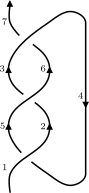
We now label each edge of the diagram with an integer: a running index that ranges from to along the orientation of the knot. In the example on above, the indices run from to .
Let
with the identity matrix, and where for each crossing , the matrix is zero except in the following blocks:
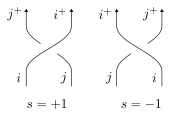
The Alexander polynomial of is then defined, up to multiplication by a unit in , as the determinant of :
Any tangle extends to non-mutant knots with the same Jones polynomial,Journal of Knot Theory and Its Ramifications, vol. 15, no. 09, p. 1153–1162, 2006. doi:10.1142/S0218216506005007