Title here
Summary here
What do knot invariants of the type introduced in invariant have to do with stochastic processes? As I shall discuss in this article, it turns out that a stochastic viewpoint of invariants is incredibly useful for understanding their properties, as well as deriving more general invariants.
The idea of considering random walks on knots, braids and tangles was proposed in [1]. Given a knot, the authors deduced properties about this knot by imagining a particle traversing on the strands. Key in this interpretation was the possibility for the particle jump from strand A to strand B when strand A crosses B. This process can be described by considering the transition matrix of a particular Markov chain.
In this post, I’ll give a description of the main ideas in [1]. I’ll assume that you know the definition of a Markov Chain, the Burau representation, as well as the information from the previous sections.
Before “jumping” into the nitty-gritty, let us start with some formalities. Recall that the Burau representation associates to every braid on strand, a matrix with entries that a rational function in a variable . In particular, the Burau representation sends every braid group generator (the crossing of strand over strand ) to a matrix that acts as the identity everywhere except in block:
The stochastic ideas in [1] are fundamentally based on Jones’ bowling alley originally introduced in [2], which the paper quotes:
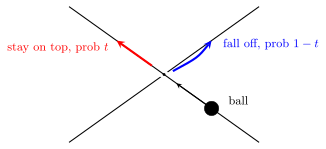
“For positive braids there is also a mechanical interpretation of the Burau matrix: Lay the braid out flat and make it into a bowling alley with lanes, the lanes going over each other according to the braid. If a ball traveling along a lane has probability of falling off the top lane (and continuing in the lane below) at every crossing then the entry of the (non-reduced) Burau matrix is the probability that a ball bowled in the th lane will end up in the th”
In this view, the Burau matrix (or representation, if you must) is rather a table that records probabilities. Indeed, upon careful inspection of the Burau matrix, we notice that
These are precisely the properties that a stochastic matrix should have. Thus, what we obtain is a Markov chain! In probabilistic language, Jones interpretation reduces to the observation that the Burau matrix is a stochastic matrix, and a bowling ball is running one step of a Markov chain on the lanes.
Let’s consider this more graphically. Figure 1 shows a single positive crossing drawn as a bowling-alley junction.
Considering braids is rather restrictive, as every strand always heads upward. In [1], this restriction is relaxed by considering so-called string links. These are defined as follows.
An example of a string link has been shown in Figure 2.
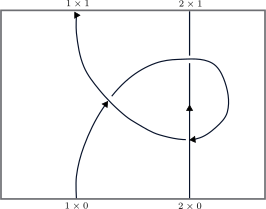
Instead of thinking about Jones’ bowling alley, we imagine a walker moving up from a point along strand of a given string link to a point . In doing so, the following rules need to be satisfied:
Any such route from to is called a path. A piece of a path that returns to where it started is a called a loop. A path is called simple if it contains no loops. There are only finitely many simple paths.
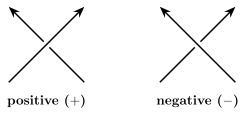
Given a path, the walker made decisions about whether they jumped down or kept on walking. To track which decision have been made, we associate to every path a weight . These weights depends on the sign of the (potentially many) crossing that are encountered when walking over a chosen path. Hence, we need to pin down what positive and negative mean. Orient both strands upward and look at which way the over-strand (the one drawn unbroken) runs: if it goes from bottom-left to top-right, the crossing is positive. On the other hand, if it goes from bottom-right to top-left, it is negative. This has been illustrated in Figure 3.
Now, the weight of a path is defined as the product of weights collected at every decision point (writing ):
This results in a matrix assigned to the string link , whose entry is the sum of the weights of all paths from to :
and it’s if no path exists. This matrix is called the Burau matrix of the string link . For a braid with only positive crossings, the choices “stay with probability , fall with probability ” correspond precisely to Jones’s bowling alley notion.
Consider the simple two-strand string link shown in Figure 1. By considering simple paths from sources to sinks, we find weights
Every path can be combined with any number of copies of the loop, and the loop sum is geometric:
Then, according to the definition above, we find
Notice that is fixed — the rows are arranged so that is always an eigenvalue.
Now, going back to the stochastic view, two properties of are to be expected:
These two properties are rigorously proven in [1]
For to truly be a stochastic matrix, one requires it to exclusively contain nonnegative entries. This can only be the case for positive string links, which are string links that are exclusively built up from positive crossings. In that case, every weight results from genuine probabilities and . In the theory of Markov chains, any stochastic matrix is the transition matrix of some Markov chain. In our case, this chain can be made explicit by making the following identification
For a positive string link the picture becomes fully stochastic. The string link in Figure 2 is not positive as the left-most crossing is a negative one. Let’s replace this crossing with a positive one. We obtain a two-strand link whose Burau matrix is equal to
Every entry is nonnegative and each row sums to
, hence this is a true stochastic matrix. This gives rise to a Markov chain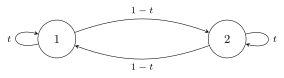
Now notice that this Markov chain describes a single traversal, not an iterated process. For this to occur, a walker that ends up at the top of the string link has to be able to move to the beginning again, i.e. if sink at the top is identified with source . This identification can be made upon closing the string link: we glue the top to bottom, . This turns the strip into an annulus.
The stochastic viewpoint is rather crucial, as it has recently been extended in the context of perturbed Gaussians by Bar-Natan and Van der Veen in [3]. This view has resulted in efficient methods to compute strong knot invariant. I will go into the details of the stochastic view of this model in a future post.
Burau representation and random walks on string links,Pacific Journal of Mathematics, vol. 182, no. 2, p. 289–302, 1998. doi:10.2140/pjm.1998.182.289
Hecke algebra representations of braid groups and link polynomials,in New Developments in the Theory of Knots, World Scientific, 1990, vol. Volume 11, p. 20–73.doi:10.1142/9789812798329_0003
A perturbed-Alexander invariant,Quantum Topology, vol. 15, no. 3, p. 449–472, 2024. doi:10.4171/qt/206